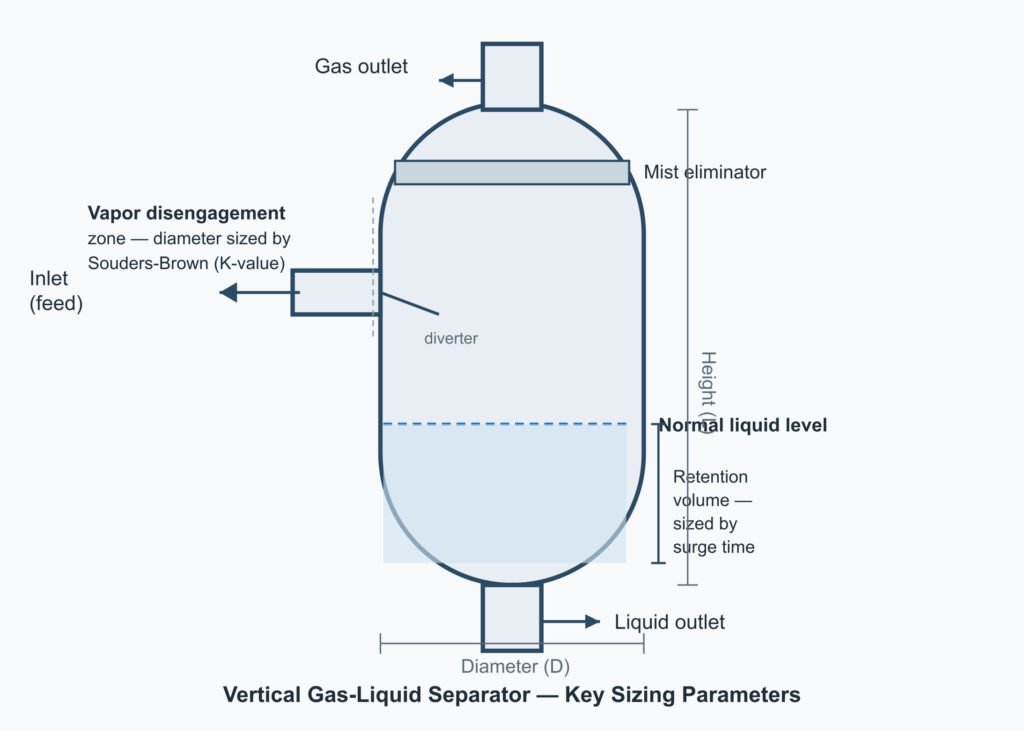
Separator sizing is one of those calculations every process engineer learns early — and one that a surprising number of us get subtly wrong for our entire careers. Not because the math is hard, but because the instinct to “add a bit of margin, just in case” compounds at every step: a conservative K-value here, a padded retention time there, an extra 10% on diameter for “operational flexibility.” By the time the vessel reaches the fabricator, you’re not looking at a separator anymore — you’re looking at a pressure vessel-shaped insurance policy, and someone is paying for it in steel, freight, and plot space.
This article walks through how to size separators correctly the first time: using recognized methods (Souders-Brown, API 12J, GPSA guidelines), understanding where real uncertainty lives in the calculation, and knowing which margins are worth keeping and which ones are just habit.
Why Over-Design Happens in Separator Sizing
Over-design rarely comes from a single bad decision. It accumulates from several small, individually reasonable-looking choices:
- Stacked conservatism. A conservative droplet size assumption, followed by a conservative K-value, followed by a conservative retention time, followed by a design margin on top of all three. Each choice is defensible in isolation; together they can inflate vessel volume by 40–60%.
- Copy-forward design. Reusing a separator datasheet from a “similar” service without re-checking whether the original basis (fluid properties, turndown, slugging behavior) actually applies.
- Vendor-driven inflation. Some fabricators quote larger vessels because larger vessels are easier to build and less likely to generate a warranty claim — not because the process requires it.
- Fear of a data point you don’t have. When physical properties or surge data are uncertain, the easy move is to oversize rather than to characterize the uncertainty and design around it deliberately.
None of these are engineering mistakes in the traditional sense. They’re the result of not having a clear method for separating necessary margin from defensive margin.
The Core Sizing Method: Souders-Brown and the K-Value
For gravity separation, the governing relationship is the Souders-Brown equation, which sets the maximum allowable superficial gas velocity before liquid droplets are re-entrained into the gas stream:
V_max = K √[(ρ_L − ρ_V) / ρ_V]
Where:
- V_max = maximum permissible vapor velocity (ft/s)
- K = Souders-Brown coefficient (empirical, depends on internals and droplet size target)
- ρ_L, ρ_V = liquid and vapor densities
The entire sizing exercise hinges on choosing K correctly. GPSA and API 12J publish standard K-value ranges for vertical and horizontal separators, with and without mist eliminators. The mistake most engineers make isn’t in the equation — it’s in defaulting to the lowest, most conservative K-value in the range without asking whether the service actually warrants it.
Practical rule: use published K-values as a starting range, not a fixed answer. Adjust based on:
- Actual operating pressure (K decreases at higher pressure due to increased droplet drag effects)
- Presence and type of mist eliminator (a properly sized mesh pad or vane pack can justify a materially higher K than a bare vessel)
- Foaming tendency of the liquid, which is a real reason to derate K — not a reason to default to the bottom of every range regardless of service
Retention Time: The Other Half of the Sizing Decision
Vapor velocity sets the vessel diameter. Liquid retention time sets the length (or the liquid holdup volume). This is where over-design creeps in just as often, because retention time is frequently selected from a generic table rather than derived from the actual control and surge requirements of the system.
Typical retention times (2–5 minutes for standard liquid-vapor separation, longer for emulsions or three-phase systems) are a reasonable starting point — but they should be checked against:
- Actual downstream control response time. If the level controller and downstream valve can respond faster than the “standard” retention time assumes, you may be carrying unnecessary holdup volume.
- Real surge scenarios, not worst-case-of-worst-case stacking. A slug catcher sized for the single largest credible slug is appropriately conservative. A slug catcher sized for that slug arriving simultaneously with a compressor trip and a control valve failure is often solving a problem that operations will manage procedurally, not one the vessel needs to absorb.
- Turndown, which usually drives the sizing envelope more than the design case. A separator that works beautifully at 100% flow but re-entrains liquid at 30% flow is undersized in the way that actually matters in operation.
A Practical Sizing Sequence That Avoids Stacking Margins
- Establish real operating envelope — normal, maximum, minimum (turndown), and any credible upset/slug case, with actual numbers rather than round-number placeholders.
- Select K-value based on the specific internals and service, not the most conservative published figure by default.
- Size diameter for vapor-liquid disengagement using Souders-Brown at the governing (usually maximum) vapor case.
- Size length/holdup for retention time and surge, checked against actual control response and instrumentation, not a generic table value alone.
- Check turndown performance, not just the design point — this is where many “correctly sized” separators actually fail in the field.
- Apply one design margin, applied once, typically a modest percentage on top of the calculated result to account for fabrication tolerance and rounding to standard vessel sizes — not a margin on top of a margin on top of a margin.
- Document the basis for every assumption (K-value source, retention time source, surge case definition) so the next engineer who touches the datasheet can tell the difference between a deliberate decision and an inherited guess.
Where Margin Is Actually Worth Keeping
Avoiding over-design doesn’t mean stripping out every safety factor — it means being deliberate about where margin earns its cost. Margin is generally worth keeping when:
- Fluid properties carry genuine analytical uncertainty (early-stage projects, limited lab data)
- The service is fouling, corrosive, or erosive, and internals will degrade over time
- Feed composition or rate is expected to change materially over the plant’s life (debottlenecking, tie-ins)
- The consequence of under-sizing is disproportionate to the cost of the extra steel — flare knockout drums and slug catchers on offshore platforms are not the place to optimize plot space
Margin is usually not worth keeping when it exists only because “that’s what we did on the last project,” or because no one wants to be the person who signed off on the smaller vessel.
The Cost of Getting This Wrong
Over-designed separators aren’t a free safety net — they carry real cost through the project lifecycle: higher vessel weight and wall thickness, larger plot footprint and structural steel, increased fabrication and shipping cost, and in retrofit or offshore work, weight and space penalties that ripple into structural and foundation design. Under-designed separators carry an even higher cost: carryover, downstream fouling, compressor or pump damage, and unplanned shutdowns. The goal of a disciplined sizing method isn’t to minimize the vessel — it’s to make sure every inch of it is doing something.
Final Thought
Good separator sizing isn’t about finding the smallest possible vessel or the safest possible one. It’s about being able to explain, line by line, why each dimension is what it is — and being confident that if you removed any single margin, the vessel would actually fail to do its job. That standard is a higher bar than “conservative,” and it’s usually a cheaper one too.
Need a second set of eyes on a separator or vessel sizing package? Eman Process Consulting provides process simulation, equipment sizing, and refinery and petrochemical engineering support using AspenTech tools and industry-standard methods (API, GPSA, ASME). Get in touch to discuss your scope.
Related reading: Practical rules for distillation column hydraulics, Building a robust crude assay in HYSYS
FAQ
What is the Souders-Brown equation used for? It calculates the maximum allowable vapor velocity in a gravity separator before liquid droplets are re-entrained into the gas outlet, and is the standard basis for sizing separator diameter.
What K-value should I use for separator sizing? Start with the range published in GPSA and API 12J for your separator type and internals, then adjust for actual operating pressure, mist eliminator type, and foaming tendency rather than defaulting to the most conservative value in the table.
How much retention time should a separator have? Typical values run 2–5 minutes for standard liquid-vapor duty, longer for three-phase or emulsion-prone services — but the figure should be checked against actual control valve and instrumentation response time, not applied as a fixed rule.
Why does over-designing a separator matter if it’s “on the safe side”? Oversized vessels cost more in steel, plot space, and fabrication, can perform worse at turndown conditions, and in offshore or retrofit projects add weight and footprint that carry their own structural cost.